

The short answer
A good tattoo landing page shows your best work in your main style first, says clearly where you tattoo, explains how booking works and gives visitors one obvious way to request a quote. It loads quickly and asks only the questions you need to assess the project. Everything else should support that goal.
Website or landing page?
People use the two words loosely, so let us separate them.
A website is your home online. It can hold your full portfolio, your story, your FAQ and several pages.
A landing page is one page with one goal. It is usually where an ad, a link in bio or a campaign sends people, and it exists to turn that visit into a request. For a website lead campaign, a focused page can make the next step clearer. A campaign designed to start conversations may send people to DMs instead.
If you are still deciding whether you need a site at all, start with whether tattoo artists need a website if they already have Instagram.
A useful order, top to bottom
Visitors often scan before they read. The order matters as much as the content. This is the structure we recommend as a starting point:
The first screen. Your name, style and city, plus one button to request a quote. Someone should quickly understand whether you are relevant to them.
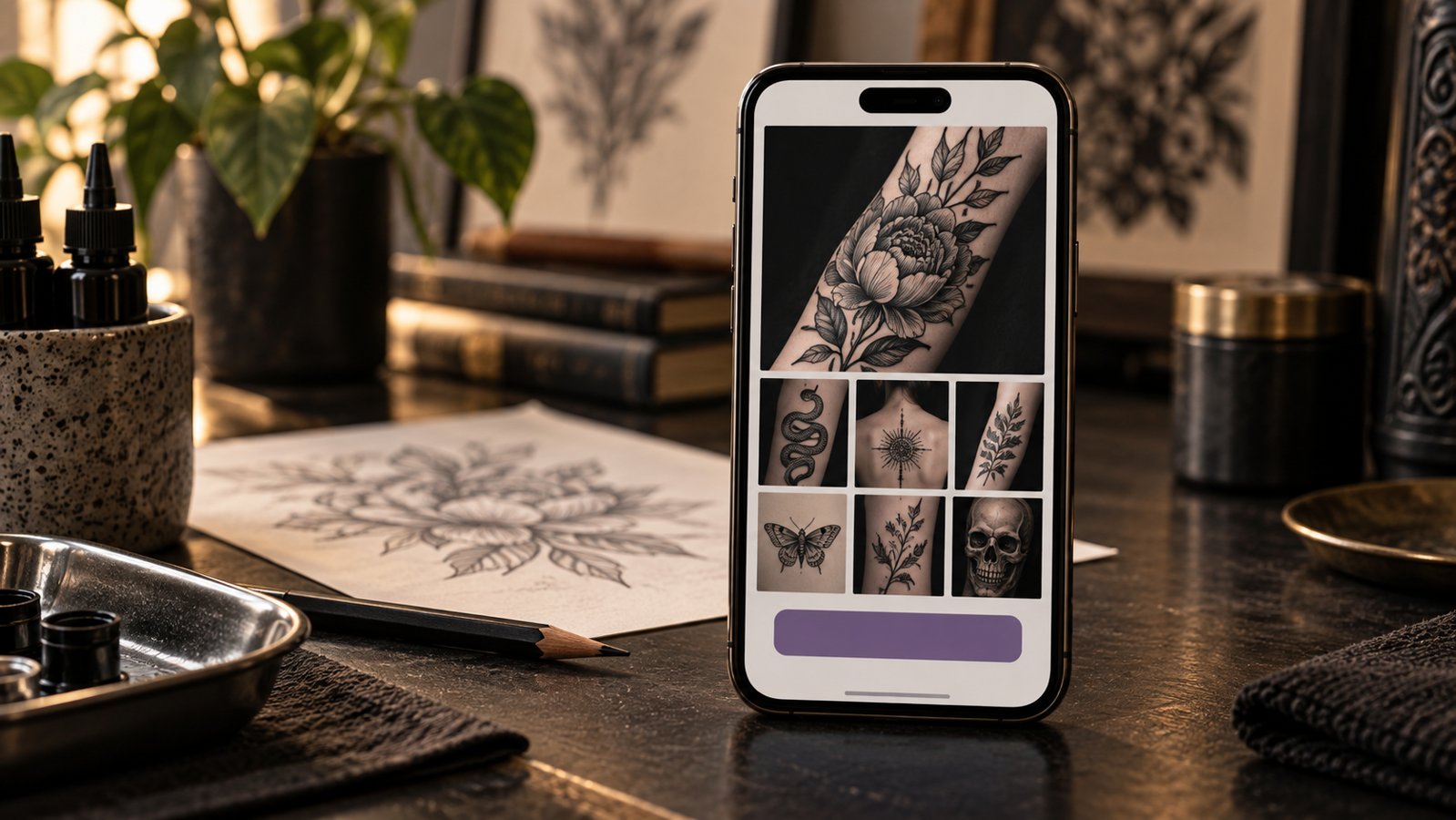
Your portfolio. Your strongest pieces in the style you want to book more of, rather than everything you have ever done. Around twenty good pieces can be plenty; a smaller, stronger selection is better than padding it out. Showing a style you no longer want to tattoo invites requests you may turn down.
How booking works. The steps, the deposit and a realistic indication of availability. Explain the process before asking someone to commit. We covered that conversation in how to ask for a tattoo deposit without losing the booking.
Proof. Recent, genuine reviews, relevant conventions or published features. Show evidence that helps a stranger understand your experience.
A short FAQ. The questions you answer in DMs every week: starting prices, preparation, aftercare instructions and whether you do cover-ups.
The request form. One clear place to send the details you need, with a realistic response-time expectation.
Speed is not just a technical detail
A slow page can lose people before they see a single tattoo.
Milliseconds Make Millions, a 2020 study commissioned by Google and carried out by 55 and Deloitte, examined 37 brands and more than 30 million sessions. For lead-generation sites, a 0.1-second improvement across four speed metrics was associated with a 21.6% increase in progression to the form submission page.
That was not a measurement of completed tattoo bookings, and it is not a promise that shaving off 0.1 seconds will produce the same result for your site. It is evidence that speed deserves attention alongside the design.
For a tattoo page, check heavy photos and autoplay videos first. Your work should look sharp without making a mobile visitor wait for oversized files.
The form: more requests or better requests?
This is a real trade-off, and many guides skip it.
Extra questions can add friction. A short form is easy to start, while a more detailed form can help you understand whether a project is a fit. The effect depends on the audience, the offer and how the questions are presented, so test it rather than assuming every extra field will hurt.
For a tattoo artist, raw submission volume is not the goal. You have a limited number of slots, and unsuitable requests take time to answer. Compare qualified inquiries and actual bookings, not just the number of messages.
Alongside a name and a reliable way to reply, ask only what you need to assess the piece:
Style
Placement and approximate size
Reference images, if the client has them
Budget range
Preferred timing
A budget range can make the question easier to answer than a blank field. Include an option for someone who needs guidance, and explain what happens after they submit.
Show proof that is recent
According to BrightLocal's Local Consumer Review Survey 2026, 68% of surveyed US consumers would only use a business rated four stars or higher, and 74% looked for reviews written in the previous three months.
This is research about local businesses generally, not tattoo studios alone. Still, it is a useful reason to show recent reviews alongside older ones. Older feedback can remain valuable; recent feedback helps show what clients are experiencing now.
Mistakes worth checking for
Sending people somewhere that does not match the ad's promise or make the next step clear.
Showing so many unrelated styles that visitors cannot tell what you want to book.
Saying only “DM me” without explaining what to send or when to expect a reply.
Leaving out your city. Nobody should have to guess where you work.
Treating every inquiry as a success without checking whether it became a suitable booking.
Frequently asked questions
Do I need a landing page if I already have a website?
Not always. If your website already leads with your work and a clear booking path, it can do the job. A separate landing page makes sense for a focused campaign, such as a guest spot or flash day, when visitors need information specific to that offer.
What should I ask in a tattoo booking form?
Ask for a name and contact details, style, placement and approximate size, optional reference images, a budget range and preferred timing. Keep only the information you need to assess the project and start the conversation.
Should I show prices on my tattoo landing page?
Custom work varies, but a starting price or a realistic range can help people decide whether to inquire. Explain what affects the quote and avoid presenting a starting price as the final cost of every project.
How many portfolio pieces should a tattoo landing page show?
Around twenty strong pieces can be a useful starting point, but there is no required number. Focus on the style you want to book. A smaller selection of relevant, well-photographed work is better than a larger, inconsistent one.
Where should my Instagram ads send people?
Match the destination to the campaign goal. A landing page can collect project details before a conversation; DMs can work if you can respond promptly. Compare qualified requests and bookings. We explain the budget side in how much Instagram ads cost for a tattoo artist.
Put the structure to work
This is what we build with Inkfolio: websites for tattoo artists and studios, with a clear path from portfolio to inquiry. You can see the layouts and current plans on the Inkfolio page.